






 A new academic study reveals that rural e-commerce delivers far-reaching benefits to China’s agricultural sector beyond expanding sales channels for farmers, effectively driving technological progress to boost farmland productivity and achieve higher output with limited land resources.
Published online on September 23, 2026, in the journal Land Use Policy, the research was jointly conducted by Haichao Yu, a researcher specializing in digital business and innovation at Beijing Technology and Business University, and Shangze Dai, a researcher in food and resource economics department at the University of Florida whose research focuses on technology and sustainable development.
Drawing on county-level statistical data across China from 2010 to 2021, the research team analyzed the expansion of “Taobao Villages” — rural communities with clustered online business operations — and its correlation with land-augmenting technological progress. This agricultural advancement refers to technological improvements that enable farmers to raise production efficiency on fixed and limited farmland.
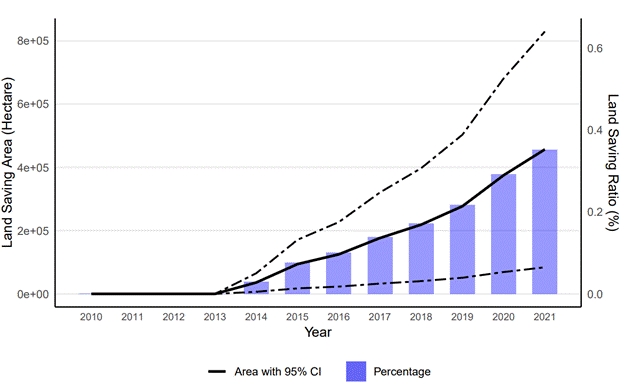
The study confirms a strong positive link between the growth of rural e-commerce and land-augmenting technological upgrading in agriculture. Researchers estimate that the productivity gains driven by rural e-commerce were equivalent to saving approximately 0.35% of China’s commonly cultivated arable land in 2021.
Digital e-commerce platforms deliver more than marketing advantages for the agricultural industry. By broadening farmers’ access to agricultural information, advanced production technologies and broader market resources, online business ecosystems incentivize the adoption of more efficient and scientific farming methods, transforming agricultural production at its core.
The research also identifies notable regional differences in the policy effect. Rural e-commerce exerts a more prominent impact on land productivity improvement in regions with mature local knowledge production and technology diffusion systems. The finding underscores the vital role of digital infrastructure and local innovation capacity in maximizing the value of rural digital economy development.
Titled Rural e-commerce and land-augmenting technological progress: Empirical evidence from China, the study provides solid empirical evidence for understanding how rural digitalization empowers sustainable agricultural development and optimizes land resource utilization.

